
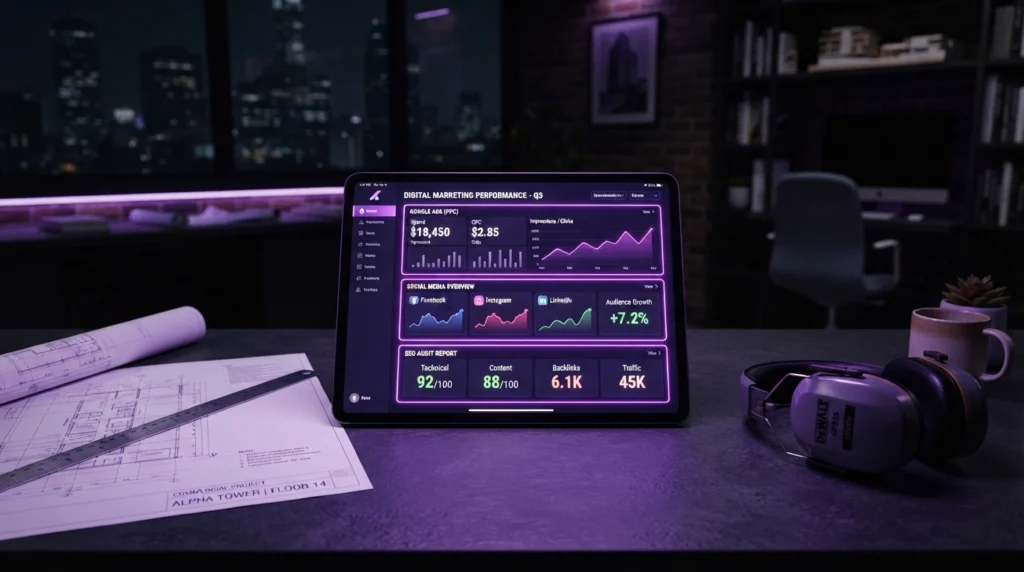
Quick answer: Marketing for contractors works when three things line up. You need a fast website with a clear page for every service you sell, a complete and verified Google Business Profile, and a steady flow of genuine reviews. Google says local results are mainly based on relevance, distance, and prominence, so the contractors who show up are the ones whose website and profile clearly match the job, cover the right area, and carry real proof. Paid ads and social posts come after those basics, not before.
Roofers, remodelers, concrete crews, insulation installers, pressure washing companies and dumpster rental outfits all face the same problem. The work is good, word of mouth is strong, and yet the phone goes quiet when referrals slow down. Many homeowners in Columbia, Spring Hill and Franklin now start a project with a search, and they judge your company in a few seconds on a small screen. This playbook covers what we build for trade and home service companies, in the order that tends to pay off.
Why Contractor Marketing Is Different
A bakery can win on foot traffic. A contractor almost never has customers walking in the door. Your customers are deciding who to let onto their property for a job that may cost thousands of dollars, and they often compare a few companies before they call. That changes what your marketing has to do.
- It has to prove you do the specific job they need, not just that you are “a contractor.”
- It has to show you work in their town, because most trades run a service area rather than a storefront.
- It has to build trust fast with photos of real work, reviews from real neighbors, and clear contact details.
- It has to make the next step easy: a call, a text, or a short quote request from a phone.
Start With a Website Built Around the Jobs You Want
Your website is the one marketing asset you fully own, and your profile, ads, and social pages all send people back to it. Our web design and development work for trades follows a few rules.
Give every service its own page
If you install roofs, repair roofs, and replace gutters, those are three different searches and three different pages. One crowded “Services” page makes it hard for visitors to find their job and hard for Google to see that you offer it. Each page should say what the job includes, which areas you cover, what the process looks like, and how to request an estimate.
The Upgrade Spray Foam project is a good example. The old site made it hard to find information about residential and commercial insulation. The redesign separated those two audiences clearly and placed quote request buttons where visitors would see them.
Organize the site so people find their job fast
When the Veteran Roofing Systems site came to us, content lacked structure, and visitors looking for a specific roofing service had trouble finding it. We started with a Figma design focused on clear structure, organized the services, improved the menu flow, and placed clear calls to action. The same thinking applied to the Camo Pressure Washing website, where each service category now has its own heading, description, and images, built on WordPress with responsive layouts.
Show the work, not stock photos
Before and after photos from real jobs do more for a contractor than any slogan. Add a short caption with the type of job and the town. Homeowners want to see that you have done a job like theirs, close to where they live.
Make calling and quoting easy on a phone
Put your phone number in the header as a tap-to-call link. Keep the quote form short: name, phone, town, type of job, and an optional photo upload. Every extra required field gives a busy homeowner a reason to call the next company instead.
For companies that want full control, a custom theme is often worth it. On the AMC Construction project, a custom home builder in Columbia, the process began with research and wireframing, moved to a Figma design, and ended with a fully custom WordPress theme built from scratch with responsive layouts for every screen size.
Speed Matters on Job Sites and in Driveways
Many contractor searches happen on a phone, often on a weak signal. Google publishes three Core Web Vitals that measure real user experience. According to web.dev, a good experience means Largest Contentful Paint within 2.5 seconds, Interaction to Next Paint of 200 milliseconds or less, and Cumulative Layout Shift of 0.1 or less, measured at the 75th percentile of page visits.
The fixes for contractor sites are rarely exotic: compress big job photos, drop homepage sliders and unused plugins, and choose decent hosting. A lighter site also shows the phone number and quote button sooner.
Set Up Google Business Profile Like a Contractor
- For many trades, the Google Business Profile is where a large share of calls start, because it shows in the map results. Google’s own guidance on improving your local ranking says to verify your business, keep information complete and accurate, respond to reviews, and add photos. It also explains that no one can pay for a better local ranking.
- Choose the primary category that matches your main job, such as roofing contractor or concrete contractor, then add secondary categories only for work you actually do.
- Set your service area to the towns and counties you truly cover. Google’s guidance asks for a full address only if customers can visit your location.
- List your services with plain descriptions that match your website pages.
- Upload real job photos regularly, including your trucks and crew if you are comfortable with it.
- Use the same business name, phone number and address everywhere, from your website footer to directories.
Reviews: Ask Every Customer and Reply to Every Review
Reviews are the proof homeowners look for. BrightLocal’s Local Consumer Review Survey 2026 reports that 97% of consumers read reviews for local businesses and that the average consumer uses six different review sites when choosing a business. Google remains one of the most used sources for local recommendations in that survey.
Build review requests into the end of every job. Text the customer your Google review link the day you finish, while the result is fresh. Google’s tips to get more reviews suggest sharing a review link or QR code and replying to reviews, and they are clear that offering discounts or free services in exchange for reviews is prohibited. Reply to negative reviews calmly and with specifics, because future customers read the replies too.
Service Area Pages Without Thin Copies
If you work across Maury and Williamson counties, a page for each main town can help. The mistake is cloning one page and swapping the city name. Those pages add little for visitors and can look like doorway pages. A useful town page includes projects you completed there, local permits or HOA notes you have learned, the neighborhoods you serve, and reviews from customers in that town.
Start with the town that brings you the most work, write that page properly, then add others as you collect real jobs and photos. Our local SEO checklist for small businesses walks through the wider local setup if you want the full list.
Structured Data and Consistent Contact Details
Structured data is code that helps search engines read your business details. Google’s documentation for LocalBusiness structured data shows how to mark up your name, address, phone number, hours, and other details. For a contractor site, adding it to the homepage or contact page is a quick technical win. Make sure the details in the markup match your Google Business Profile and your footer exactly. Mismatched phone numbers and old addresses confuse customers and search engines alike.
Where Paid Ads and Social Media Fit
Google Ads and social media advertising can fill the calendar quickly, but they multiply whatever your website already does. If the site is slow or confusing, ads simply buy more visitors who leave. Once your service pages, quote form, and reviews are in good shape, paid search for high intent terms and social ads showing finished projects can make sense. Our digital marketing services cover SEO, pay-per-click advertising, Google Ads management, social media, and email, so the pieces can be planned together.
Whatever you run, track it with call tracking on ads, a tagged Google Business Profile link, and a simple question to every new customer about how they found you.
A Simple 90 Day Plan
- Month one: fix the basics. Verify and complete your Google Business Profile, confirm your name, address, and phone number match everywhere, add a tap to call and a short quote form, and compress images.
- Month two: build service pages for your top three jobs, each with real photos and a clear call to action. Start texting review requests after every job.
- Month three: add a project gallery, write your first town page based on real work, add LocalBusiness structured data, and review your analytics to decide whether ads are worth testing.
Frequently Asked Questions
Q. What is the best marketing for contractors?
A. For most contractors, the best return comes from a fast website with one page per service, a complete Google Business Profile, and a steady stream of genuine reviews. Paid ads work better once those basics are in place.
Q. Do contractors really need a website if they have a Google Business Profile?
A. Yes. The profile gets you seen in the map results, but homeowners usually click through to check photos, services, and credibility before calling. A website you own also keeps working if your profile or ad account ever has problems.
Q. How many service pages should a contractor website have?
A.Create one page for each job you want more of and can describe in detail. A practical starting point is three to six pages, then add more as they collect project photos and reviews for each service.
Q. Should I list my home address on Google Business Profile?
A. Google asks for a full address only if customers can visit your location. Contractors who travel to job sites and do not serve customers at their address can set a service area instead and keep the street address hidden.
Q. How do I get more Google reviews without breaking the rules?
A. Ask every customer at the end of the job and send your review link or QR code by text. Do not offer discounts or free services in exchange for reviews, which Google prohibits.
Q. Are town pages for Columbia, Spring Hill and Franklin worth it?
A. They can be, as long as each page contains real local content such as completed projects, local reviews, and details about that area. Copied pages with only the city name changed add little value.
Q. How long does it take to see results from contractor marketing?
A. Profile, review, and contact fixes can help quickly, while new pages and local rankings usually build over several months, depending on competition and consistency.
Talk to AMC Digital About Your Contractor Website
AMC Digital designs and builds websites for trade and home service companies in Middle Tennessee, and you can see real examples on the project pages linked above. If you want a site and local presence built around the jobs you want, call +1 931 416 5131, email info@amcdigital.io or visit us at 2348 Tom Fitzgerald Rd, Columbia, TN 38401. You can also request a free consultation online.