

Sooner or later, every small business owner who wants more customers online asks this question. Both channels send people from Google to your website, but they work in very different ways. The right pick depends on your budget, your timeline, and how soon you need the phone to ring. This guide lays out the differences in plain language so you can decide with confidence.
At AMC Digital, our team helps small businesses, contractors, and startups across Tennessee get found on Google. We run both channels, so we see where each one shines and where each one stumbles. Here’s what we’ve learned.
SEO vs. PPC: What’s the Difference?
SEO (search engine optimization) earns you free, organic rankings. PPC (pay-per-click advertising) buys you a spot at the top of the results page. For most small businesses, Google Ads is the PPC platform that matters.
The short version:
- SEO: You improve your website, content, and local listings until Google ranks you higher. You don’t pay per click.
- PPC: You bid on keywords and pay every time someone clicks your ad.
- Speed: PPC starts fast. SEO builds slowly.
- Staying power: SEO keeps working over time. PPC stops the moment your budget does.
How Google Ads Works
You pick keywords, write an ad, and set a budget. Each time someone searches, Google runs a quick auction to decide which ads show up. (You can read how the Google Ads auction works on Google’s help site.) Your position depends on your bid and your Ad Rank, which rewards relevant ads and useful landing pages, so a big bid alone won’t win.
If you’d rather hand off the setup and the daily upkeep, our Google Ads management service covers it.
What Google Ads does well
-
- Fast results. Ads can bring visitors within days of launch.
- Precise targeting. You choose the location, keywords, device, and time of day.
- Clear tracking. Clicks, calls, and form fills all show up in one place.
- Budget control. You set a daily limit and change it whenever you want.
Where Google Ads falls short
- Traffic stops the moment you stop paying.
- You pay for clicks even when visitors don’t buy.
- Competitive industries get expensive.
- Campaigns need steady management, or they waste money.
How SEO Works
SEO helps Google understand your website and trust it. You tighten up page titles, content, site speed, and local listings so your pages appear when customers search. Google’s own SEO starter guide covers the basics every site should get right, and Google Search Console lets you track your progress for free.
SEO takes patience. How long does SEO take? Months, not days. Your competition and your site’s starting point set the pace.
What SEO does well
- Lasting value. Good rankings can keep bringing visitors long after the work is done.
- No cost per click. Organic visitors don’t charge you a fee when they arrive.
- Wider reach. You also reach searchers who skip ads entirely.
- Compounding growth. Every new page, review, and update adds to your visibility.
Where SEO falls short
- The start is slow, and results are never guaranteed.
- It demands steady effort on content, updates, and technical checks.
- You control your website, but you don’t control Google.
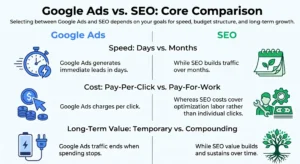
Google Ads vs. SEO: Side by Side
| Factor | Google Ads | SEO |
| Speed | Days | Months |
| Cost model | Pay per click | Pay for the work, not the clicks |
| Long-term value | Ends when spending ends | Builds over time |
| Control | High control over budget and targeting | Less control; depends on Google |
| Best for | Urgent leads and new offers | Steady growth and local visibility |
| Tracking | Clear click and call data | Slower, trend-based |
Costs for both CPC and SEO campaigns vary widely with industry competition, location, and campaign scope. A plumber in a small town and a personal injury lawyer in a big city face very different prices. For a closer look at agency pricing, read what an SEO agency costs.
Which Is Better for Local Businesses?
Both channels matter for a local service business, but local SEO deserves extra attention. When people search for a service near them, they often see map results first. A complete Google Business Profile, steady reviews, and consistent contact details help you land there. Our Google Business Profile optimization guide walks you through each step. A strong map listing also keeps sending calls long after you stop paying for anything.
Google Ads fills the gaps. A roofer, for example, can run ads during storm season while local SEO builds visibility the rest of the year.
Which Is Better for a New Business or Startup?
A brand-new website has no authority yet, so SEO moves slowly at first. Ads can bring in your first customers while your SEO foundation grows.
Start with Google Ads if:
- You need leads this month.
- You’re testing a new service or offer.
- You want fast data on which keywords bring calls.
Start with SEO if:
- Your budget is tight, and you can wait for results.
- People search for your service all year.
- You want to lean less on paid clicks over time.
Should You Use Both Together?
For many small businesses, yes. That’s the real answer behind the SEO vs. PPC debate: the two channels support each other instead of competing. Think of ads as the sprint and SEO as the long run. You need both to cover the full distance.
- Ads show you which keywords bring calls, so you can build SEO content around them.
- Strong landing pages lift your organic rankings and your ad quality at once.
- Appearing in both ads and organic results claims more space on the page.
- Shared data helps you spend smarter on both.
Not sure where to start? Our marketing audit guide shows what to review before you spend a dollar.
How to Decide: 5 Questions to Ask
- How fast do I need new leads?
- What monthly budget can I commit?
- How competitive is my industry and my area?
- Does my website turn visitors into calls and form fills?
- Who will manage the work week after week?
If your website is weak, fix it before you pay for traffic. Sending ads to a confusing page burns money, and no amount of clever bidding fixes that.
Common Mistakes to Avoid
Most of these cost small businesses real money:
- Sending ads to a homepage with no clear next step.
- Expecting SEO results after a few weeks.
- Skipping call and form tracking.
- Ignoring your Google Business Profile.
- Judging either channel after just one month.
Frequently Asked Questions
Q. How long does SEO take to show results compared with paid ads?
A. SEO usually needs several months to show steady results, because search engines take time to crawl, index, and rank new work. Google Ads can send traffic within days, but it stops when you stop paying.
Q. Is SEO better than PPC for quick leads?
A. No. PPC usually wins here, since ads can appear as soon as Google approves your campaign. SEO builds slower but keeps working without a per-click fee. Many small businesses start with ads and add SEO later.
Q. Which is better for a local service business, Google Ads or SEO?
A. Both help. Local SEO, including a complete Google Business Profile, brings steady calls from map results. Google Ads adds fast leads for urgent jobs. Start with whichever fits your budget and timeline.
Q. Can I run Google Ads and SEO at the same time?
A. Yes, and plenty of businesses do. Ads give you fast keyword data to guide your SEO content, and over time SEO lowers your reliance on paid clicks. Track calls and form fills from each channel so you can see what actually earns its keep.
Q. Do I need to keep paying for Google Ads and SEO every month?
A. Google Ads stops sending clicks when you stop paying. SEO needs ongoing updates and checks to hold your rankings, though past work often keeps helping. Costs vary by industry, location, and scope.
Not Sure Which to Choose?
The right answer depends on your goals, your budget, and your market. Google Ads vs. SEO isn’t a winner-take-all decision. Start with the channel that fits your timeline, track what happens, and add the other as your business grows.
Want a quick look at your local visibility? Run our free AI local marketing audit to check your Google Maps ranking, your ChatGPT visibility, and your top local competitors in minutes. Prefer to talk it through? Call us at +1 931 416 5131.