

A digital marketing audit is a full review of how your business shows up and performs online. It looks at your website, search rankings, local listings, ads, social media, and tracking, then tells you what works, what’s broken, and what’s costing you leads. If your marketing keeps you busy but your phone stays quiet, an audit is the fastest way to find out why.
At AMC Digital, our team reviews marketing for small businesses, contractors, and startups across Tennessee. This guide covers what an audit includes, gives you a checklist you can use today, explains how often to run one, and helps you decide whether to do it yourself or hire an expert.
What Is a Digital Marketing Audit?
Think of it as a health check for your online presence. Instead of guessing, you look at real data: how fast your site loads, which keywords bring in traffic, whether your Google listing is complete, and where visitors give up before they contact you.
The goal isn’t a thick report that collects dust. You want a short, ranked list of fixes that bring in more calls, form fills, and sales.
What Does a Marketing Audit Include?
A complete audit covers seven areas. Smaller businesses may only need a few, but seeing the whole picture helps you decide where to start.
1. Website Audit
Your website is the hub of your marketing, so check it first. Look at the design, mobile layout, navigation, calls to action, and page speed.
Speed deserves extra attention because slow pages lose visitors and rankings. Google measures real-user experience through Core Web Vitals, and you can test your own pages for free with PageSpeed Insights.
If the audit shows the site itself is the problem, our web design and development services can fix structure, speed, and conversion issues in one project.
2. SEO Audit
An SEO audit checks whether search engines can find, read, and rank your pages. It covers technical health, on-page elements like titles and headings, and content quality.
Google’s SEO starter guide explains the basics every site should get right. An audit also shows which keywords you already rank for and which pages sit close to page one. Our SEO and lead generation services often start with this kind of review.
3. Local SEO and Google Business Profile Audit
If you serve a specific area, your Google Business Profile can matter as much as your website. This part checks your categories, hours, service areas, photos, reviews, and whether your name, address, and phone number match across the web.
Want the step-by-step fix? Read our Google Business Profile optimization guide.
4. Paid Advertising Audit
Running Google Ads or other paid campaigns? Then the audit follows your money. It checks keyword targeting, ad copy, landing pages, budgets, and conversion tracking. The usual finds: wasted spend on irrelevant searches and ads that send traffic to weak pages.
5. Social Media Audit
Look at which platforms your customers actually use, how often you post, and whether your profiles look consistent. For many local businesses, a few well-kept profiles beat posting everywhere.
6. Analytics and Tracking Audit
If you can’t measure it, you can’t improve it. Confirm your analytics work, that calls, forms, and purchases count as conversions, and that your reports show numbers you can trust.
7. Competitor Analysis
Last, compare yourself to the businesses customers choose instead of you. Look at their rankings, reviews, content, and offers to see where you trail and where you can win.
Why Does Your Business Need an Audit?
Marketing moves fast, and small problems pile up. An audit helps you:
- Find hidden problems. A broken form or missing tracking can quietly cost you leads for months.
- Stop wasting budget. You see which channels bring results and which only bring bills.
- Prioritize the right fixes. You start with what matters most.
- Understand your competitors. You learn what the businesses above you do differently.
Signs It Is Time for an Audit
Consider an audit if any of these sound familiar:
- Your traffic is flat or dropping.
- You get website visits but few calls or form submissions.
- Your ads cost more than they bring in.
- You redesigned your site, and rankings dropped.
How Often Should You Run an Audit?
Run a full audit once a year and a lighter check every quarter. Add an extra one after a redesign, a big swing in rankings, or a new campaign.
Digital Marketing Audit Checklist: 15 Things to Check
Use this checklist as a quick self-review. If you answer “no” to several items, start there.
Website
- Does your site load quickly on mobile and desktop?
- Is it easy to use on a phone, with a clear phone number and contact button?
- Does every key page have one clear call to action?
- Do your forms and click-to-call buttons work?
SEO
- Does every page have a unique title and meta description?
- Do your main services each have their own page?
- Are there broken links or pages that don’t appear in Google?
- Does your content answer the questions customers actually ask?
Local
- Is your Google Business Profile complete, with the right categories?
- Do your name, address, and phone number match everywhere?
- Are you collecting and answering customer reviews?
Ads, Social, and Tracking
- Do your ads send traffic to relevant landing pages?
- Are your social profiles active and consistent with your brand?
- Do calls, forms, and sales count as tracked conversions?
- Do you review results every month?
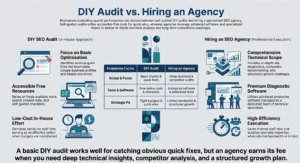
DIY Audit vs Hiring an Agency
You can run a basic audit yourself with free tools and the checklist above. It works well for obvious problems like slow pages or an incomplete Google listing.
An agency earns its fee when you need deeper technical checks, competitor data, and a priority plan, or when you don’t have the time. Weighing outside help? Our guide on how to choose a WordPress development agency shows what to look for.
What Happens After the Audit?
An audit only pays off if you act on it. A good process ends with:
- A ranked list of issues, sorted by impact and effort.
- Quick wins you can fix within days.
- A 90-day action plan for bigger work.
- A follow-up check to measure what changed.
See how this kind of work turns into real results in our recent client projects.
Frequently Asked Questions
Q. How much does a marketing audit cost?
A. It depends on your business size and how deep the review goes. A basic automated check can be free; a detailed agency review is paid. Ask for a written scope.
Q.How long does a marketing audit take?
A. A simple local audit takes minutes. A full review of your website, SEO, ads, and competitors takes a few days to a couple of weeks.
Q. What is the difference between an SEO audit and a marketing audit?
A. An SEO audit zeroes in on search visibility: technical health, keywords, and content. A marketing audit goes wider. It covers SEO plus your website, ads, social media, analytics, and competitors.
Q. Can I do a marketing audit myself?
A. Yes. Use the checklist above and free tools like PageSpeed Insights and Google Search Console. For competitor data and a priority plan, an expert saves time.
Q. Can I get a free audit?
A. Yes, for local visibility. Our free AI tool checks your Google Maps ranking, ChatGPT visibility, and top local competitors. It doesn’t replace a full review of your website, ads, and social media.
See Where Your Business Stands
Want a quick look at your local visibility? Run our free AI local marketing audit and check your Google Maps ranking, ChatGPT visibility, and top local competitors in minutes.
Need a full review of your website, SEO, and ads? Talk to our team, and we’ll walk you through what we find and what to fix first. You can also call us directly at 931 416 5131 to discuss your digital marketing needs and take the next step toward growing your business.