
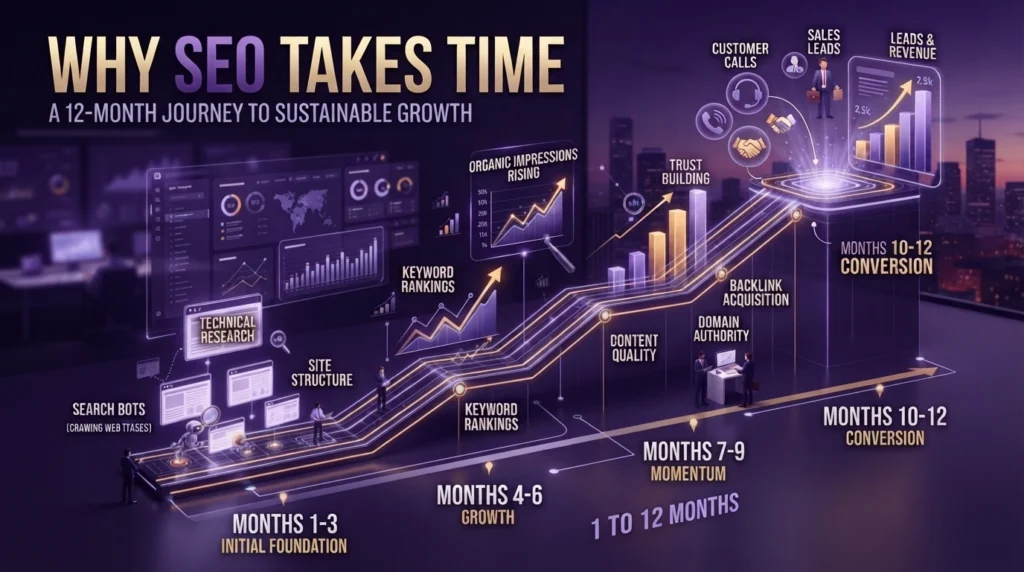
If your website gets visitors but no calls, no form fills, and no sales, you are probably wondering how long does SEO takes before it finally pays off. Most businesses see early movement in three to six months and real lead growth between six and twelve months. Working with professional SEO services shortens the wait because the right fixes happen in the right order instead of by trial and error.
Google itself says SEO changes can take months to show up in search results. You can read it in Google’s official guidance on SEO timelines. Slow results do not mean SEO is failing. They mean search engines need time to crawl, understand, and trust your changes. Once you know the real timeline, you can budget smarter and stop panicking at week three.
Key Points at a Glance
- Months 1 to 3: early signs like better indexing, fixed errors, and small ranking moves.
- Months 4 to 6: more impressions, more clicks, and the first real leads.
- Months 6 to 12: steady organic sales and stronger rankings on competitive terms.
- New sites take longer than existing sites that already have history.
- Competition, content quality, and site speed change the timeline more than anything else.
Why SEO Is Not Instant
Search engines do not rank a page at the moment you publish it. First, Google has to find the page. Then it has to decide what the page is about, compare it with thousands of similar pages, and watch how real people respond to it. Trust builds slowly; the same way a new restaurant needs months to earn regulars.
This is also why quick-fix promises are risky. Shortcuts like bought links or copied content can give a short spike and then a painful drop. Honest SEO builds a base that keeps working long after the first month.
How Long Does SEO Take Month by Month?
Here is a realistic picture of what happens at each stage. Your numbers will vary, but the order of events is very consistent.
Months 1 to 3: Technical Setup and Foundation
This stage is mostly invisible to visitors, but it matters most. We audit your site, fix crawl errors, clean up page titles, and map keywords to the right pages. Speed and mobile usability are checked too, since a slow site loses both rankings and buyers. Many businesses need website design and performance fixes before content can even perform. Expect small gains here, such as more pages indexed and a few keywords moving up.
Months 4 to 6: Content and Local SEO
Now the new content starts to work. Service pages get rewritten around what buyers actually search, and blog posts answer questions that bring in the right people. Local businesses should also tighten up their Google Business Profile. You can run our free GBP audit tool to see what is missing. Industry research backs up the patience needed here. This Ahrefs study on SEO ranking timelines shows that most new pages take a long time to reach the top results. This is usually when the first steady leads appear.
Months 6 to 9: Ranking and Traffic Growth
By now your pages have history, and Google has enough data to rank them with more confidence. Traffic climbs, impressions rise, and more keywords land on page one. This is also when owners start looking to scale, so it helps to explore our digital-marketing services before expanding your plan.
Months 9 to 12: Compounding Results
Early work now supports new work. Fresh pages rank faster, older pages hold their spots, and organic traffic turns into a more predictable source of leads. At this point, you can focus less on fixing and more on growing.
New Sites vs Existing Sites: The Difference
The starting point changes everything. Here is how the two compare.
New website
- No history or trust with Google yet.
- Few or no backlinks.
- Usually needs 8 to 12 months for strong results.
- Best strategy is low-competition, specific keywords first.
Existing website
- Has some history, indexed pages, and possibly backlinks.
- May carry old problems like thin content or broken pages.
- Often sees early gains in 3 to 6 months once issues are fixed.
- The best strategy is an audit, cleanup, and then growth.
The main difference between the two is trust. An older site is not always faster, though. A site with messy structure or past penalties can be slower to recover than a clean new one.
What Speeds Up or Slows Down Your Results
Several factors decide how soon you see sales. Some are in your control, and some are not.
Things that speed up results
- A fast, mobile-friendly website.
- Content that answers real buyer questions.
- A clear site structure with strong internal links.
- Quality backlinks from trusted sites.
- Consistent work every month.
Things that slow results down
- Heavy competition in your industry or city.
- Thin, copied, or outdated content.
- Technical errors that block crawling.
- Starting and stopping your SEO plan.
- Targeting only broad terms with huge competition.
Domain age and authority also matter. A Semrush ranking study of 28,000 domains shows that sites with backlinks and stronger authority are more likely to reach the top results. Competition varies a lot by industry, too. A pressure washing company in a small town can often rank sooner than a law firm in a big city. You can see this in action in our local business SEO case study.
Rankings vs Sales: A Key Difference
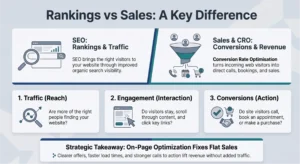
Many owners track rankings and forget about revenue. These are not the same things. A page can sit at number three on Google and still bring no sales if the message is weak, or the form is hard to find.
This is where conversion rate optimization comes in. Good SEO brings the right visitors. Good CRO turns those visitors into calls and orders. Look at both:
- Traffic: Are more of the right people finding you?
- Engagement: Do they stay, scroll, and click?
- Conversions: Do they call, book, or buy?
If traffic grows but sales stay flat, the fix is often on the page itself. Clearer offers, faster load times, and stronger calls to action can lift sales without any extra traffic.
Why Is My Ranking Dropping?
A dip does not always mean something is broken. Rankings move up and down during Google updates, when competitors publish new content, or when you change your pages. Check for new technical errors first, then look at whether a competitor passed you with better content. Avoid making big changes in a panic, since that can make things worse. If you want to know how we handle these moments, read our common questions about our process.
Frequently Asked Questions
Q: How long does SEO take to bring leads to a small business?
A: Most small businesses see early lead growth in three to six months. Stronger, steady leads usually show up between six and twelve months, depending on competition, site quality, and how consistently you publish and fix issues.
Q: Can SEO work faster if I only target local keywords?
A: Often, yes. Local searches have fewer competitors, so you can rank sooner than for broad terms. A complete Google Business Profile, local pages, and reviews usually help you gain ground within a few months.
Q: Is SEO slower or faster than paid ads?
A: Paid ads bring clicks the day you launch, but they stop when the budget stops. SEO takes months to build, yet it can keep sending visitors without a cost per click. Many businesses use both while SEO grows.
Q: Why is my traffic going up but my sales are not?
A: Traffic only helps if visitors match your offer. Check that your pages target buyer keywords, load fast, and have clear calls to action. Conversion rate optimization often fixes this gap faster than adding more traffic.
Q: How do I know if my SEO is working after a few months?
A: Look for more impressions and clicks in Google Search Console, better rankings for target terms, and more calls or form fills from organic visits. Steady gains month over month show the plan is on track.
Final Thoughts
So, how long does SEO take for your business? Plan on three to six months for early results and up to twelve months for strong, steady growth. The wait is worth it because organic traffic keeps working while you run your business. If you want a clear plan based on your site, your market, and your goals, ask for a custom SEO proposal or call +1931 416 5131 today.